
For simplicity all types of ground reinforcement are referred to as “anchors” on this page.
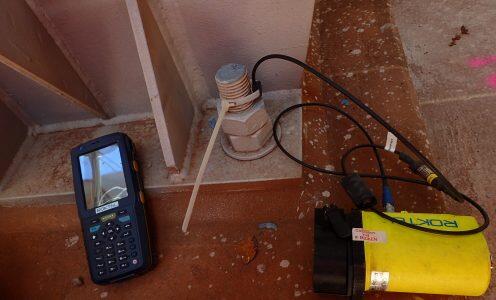
RokTel is a complete, user-friendly system in a small, light and flexible format. It is composed of a robust control and actuator unit with data capture sensors and a ruggedised hand-held PC graphical control interface; all components are rated IP65 as a minimum. The sensors and actuator system attach to the ground reinforcement using quick attach/release clips, and the actuator communicates wirelessly (or by cable) with the operator interface, which has belt clips for ease of handling in awkward test situations.
Key features
- Accurate condition assessment
- Immediate indications for ‘good’, ‘bad’ and ‘caution’
- Enables testing of 150+ reinforcements per shift
- Unique dual acoustic and vibration sensors
- Up to 18 hours test time per charge
- Fast, simple attachment system for multi-format reinforcements
- Full in-depth analysis support provided as standard
- Optional custom attachments by application
Why RokTel?
Traditional assessments of structural ground anchors such as rock anchors, soil nails or tendons involve using a hydraulic ram to apply a ‘pull’ stress of several tons. If the anchor moves significantly it is considered substandard and replaced; if it moves by no more than a few millimetres it is considered ‘good’ and normally left in place. This method has several drawbacks:
- It is destructive: even in good anchors, the test can break the anchor/grout bond to the substrate, seriously weakening the reinforcement.
- No data is obtained from anchors left in place, so remaining length, corrosion level and grout bond/voids go undetected.
- The machinery is heavy and awkward to transport and operate.
- Only a few tests can be carried out per day or shift.
- ‘Good’ anchors can be removed unnecessarily.
RokTel is a fast, reliable, non-destructive method of triaging 100–200 anchors per operator, per shift. Good and bad anchors can be identified, together with remaining length, level of corrosion, grout adhesion and voids.
In-depth condition analysis
RokTel determines the following in-situ parameters of the anchor:
- Severity of corrosion
- Remaining anchor length
- Grout adhesion coverage
- Grout voids
In addition to on-site indications of condition, internet-based support and in-depth analysis is available online, with individual test reports provided.
How does RokTel work?
RokTel comprises an intelligent electronic actuator which ‘taps’ the exposed end of the ground reinforcement with a precise force, and dual sensors which capture the reinforcement’s vibration and acoustic response. The force of impact is selectable for different conditions or anchor sizes and is closely controlled by the patented actuator system, giving perfectly repeatable impacts across all anchors in a series.
The sensor unit combines acoustic and vibrational measurement. Algorithms integrate the two to determine the length, grout adhesion, voids and degree of corrosion of the anchor under test. Data is recorded by the actuator unit and transmitted to the graphical control programme on the ruggedised hand-held computer, wirelessly or by cable for wireless-sensitive sites. The programme graphs the vibrational data and displays the condition as good (green), bad (red) or caution (orange). At the end of a test series the data is uploaded to the central analysis system, and a detailed report is returned.
Is RokTel a new innovation?
The team that designed RokTel has received many national and international awards for innovation and applied technology. The first versions were developed by CCPS in 2008 and have been in use in many countries for several years, proven capable of a high degree of accuracy in assessing in-situ anchor condition.
Does the system work, and is it reliable?
Operational testing has taken place on several thousand ground anchors of many types in many countries, including Canada, Australia, the UK, Austria, Indonesia, Greece and the USA. Accuracy has been proven by extraction in underground mines, bridges and ground stabilisation applications, and there have been no negative reports regarding the accuracy of RokTel analysis. Some reinforcement types, such as split-set anchors, are more difficult to attach to, and development to increase flexibility is ongoing.
Perfect consistency
Tapping the free end of the anchor with a hammer may seem simpler, but a hand-operated hammer cannot duplicate the force of a strike, so the returned data is confused and harder to analyse. The patented electronic impactor is accurately metered to use the optimum force, avoiding confusing responses and ensuring clear data.
Problem-free design
Impact analysis of rock anchors has other difficulties: a high-mass impactor adds to the free-end mass of the anchor and affects its response, and can create its own vibrations that transmit to the anchor. Three types of vibration arise in the anchor – longitudinal, transverse and surface – and the longitudinal waves are the most useful for detecting length, corrosion and grout. Impacting anywhere other than the exact end of the anchor can emphasise the unwanted types and degrade the analysis. The patented RokTel system is designed to avoid or overcome these problems.